
Bitcoin continues to struggle below the $65,000 level as persistent selling pressure weighs on market sentiment. Price action has remained fragile in recent weeks, with volatility elevated and traders showing limited conviction amid tightening liquidity conditions and broader macro uncertainty. While intermittent rebounds have occurred, they have so far failed to establish sustained upside momentum, leaving Bitcoin locked in a cautious consolidation phase below a key psychological threshold.
A recent CryptoQuant report highlights a notable structural development involving StrategyB, formerly known as MicroStrategy. It has now been more than six years since the company began its Bitcoin accumulation strategy, targeting roughly 5% of the asset’s total supply. The initiative, driven by CEO Michael Saylor — one of Bitcoin’s most vocal long-term advocates — reflects a conviction that BTC could eventually surpass the $1 million mark over time.
To pursue this objective, StrategyB has executed what many consider the largest dollar-cost averaging program in Bitcoin’s history, notably without selling any BTC since inception. Annual investment figures illustrate the scale of this effort: $1.1 billion in 2020, $2.57 billion in 2021, $276 million in 2022, $1.9 billion in 2023, $21.9 billion in 2024, $22.4 billion in 2025, and $4.1 billion so far in 2026.
StrategyB’s Aggressive Bitcoin Accumulation And Market Implications
According to the report, 2025 marked a record year for StrategyB in terms of capital deployed, with more than $22.4 billion invested into Bitcoin accumulation. The data suggests that 2026 is currently following a comparable trajectory. If this pace continues, the firm could surpass last year’s record, further consolidating its position as one of the largest institutional holders of BTC.

At present, Bitcoin is trading below StrategyB’s estimated realized price, which sits near $76,000. This metric reflects the company’s average acquisition cost across its holdings. StrategyB reportedly holds approximately 717,131 BTC, equivalent to around 3.4% of Bitcoin’s circulating supply. Such concentration highlights the scale of institutional participation now embedded in the market structure.
However, the interpretation of this data requires caution. Trading below a large holder’s realized price does not automatically imply undervaluation; realized price is a cost-basis metric, not a valuation model. Market conditions, liquidity flows, and macroeconomic variables remain dominant drivers of price direction.
Still, the broader takeaway is notable: even major institutional participants often rely on relatively simple accumulation strategies such as dollar-cost averaging. Whether that approach proves optimal in current conditions depends on individual risk tolerance, time horizon, and broader market context.
Weekly Breakdown Below Key Moving Averages Signals Structural Weakness
Bitcoin’s weekly structure has deteriorated materially over the past several sessions. After failing to sustain acceptance above the $90,000–$100,000 region, price rolled over and has now retraced toward the mid-$60,000 area. The latest weekly close near $66,000 places BTC decisively below the 50-week and 100-week moving averages, both of which are beginning to slope downward.
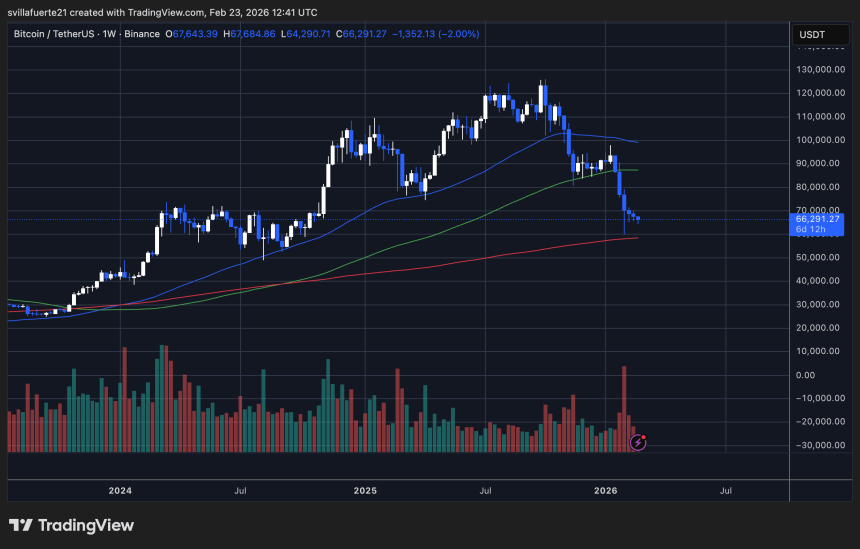
This shift in positioning is technically significant. During the 2024–2025 advance, these moving averages acted as dynamic support, consistently absorbing pullbacks and reinforcing trend continuation. Their loss now converts them into overhead resistance, limiting upside unless reclaimed with strong volume confirmation.
The 200-week moving average, currently tracking near the mid-$50,000 zone, remains the last major structural support on this timeframe. Historically, sustained closes below the 50-week average following a cycle peak have signaled prolonged corrective phases rather than shallow consolidations.
Volume has expanded during the recent breakdown, suggesting distribution rather than simple low-liquidity drift. The sharp selloff from the $90,000 region to sub-$70,000 levels reflects decisive supply entering the market.
For bulls to regain control, BTC would need to reclaim the $75,000–$80,000 range and reestablish higher weekly highs. Until then, the weekly trend favors caution, with momentum tilted toward continued consolidation or further downside exploration.
Featured image from ChatGPT, chart from TradingView.com