Author: admin

  • Bitcoin Price Sinks to New Weekly Low, Bulls Lose Key Support

    Bitcoin Price Sinks to New Weekly Low, Bulls Lose Key Support

    Bitcoin price failed to stay above $66,000 and dipped further. BTC is now consolidating losses and might struggle to recover above $66,000.

    • Bitcoin started a fresh decline and traded below the $66,000 support.
    • The price is trading below $65,500 and the 100 hourly simple moving average.
    • There is a bearish trend line forming with resistance at $66,800 on the hourly chart of the BTC/USD pair (data feed from Kraken).
    • The pair might dip again if it trades below the $63,500 and $63,200 levels.

    Bitcoin Price Breaks Key Support

    Bitcoin price failed to remain stable above the $66,500 zone. BTC started a fresh decline and traded below the $66,000 support zone. There was a push below $65,000.

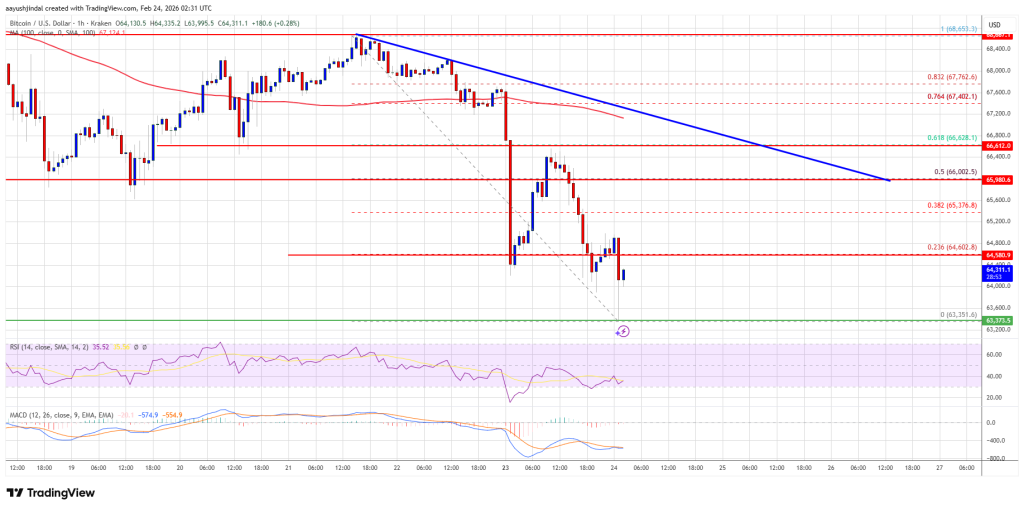
    The price even spiked below $64,000. A low was formed at $63,351, and the price is now correcting some losses. There was a move above $64,000, but the price is still well below the 23.6% Fib retracement level of the recent decline from the $68,652 swing high to the $63,351 low.

    Bitcoin is now trading below $66,000 and the 100 hourly simple moving average. If the price remains stable above $64,000, it could attempt a fresh increase. Immediate resistance is near the $64,600 level.

    The first key resistance is near the $65,250 level. A close above the $65,250 resistance might send the price further higher. In the stated case, the price could rise and test the $66,000 resistance or the 50% Fib retracement level of the recent decline from the $68,652 swing high to the $63,351 low.
    Bitcoin Price

    Any more gains might send the price toward the $66,800 level. There is also a bearish trend line forming with resistance at $66,800 on the hourly chart of the BTC/USD pair. The next barrier for the bulls could be $67,500 and $67,700.

    Another Decline In BTC?

    If Bitcoin fails to rise above the $65,250 resistance zone, it could start another decline. Immediate support is near the $64,000 level. The first major support is near the $63,500 level.

    The next support is now near the $63,200 zone. Any more losses might send the price toward the $62,650 support in the near term. The main support now sits at $62,000, below which BTC might struggle to recover in the near term.

    Technical indicators:

    Hourly MACD – The MACD is now gaining pace in the bearish zone.

    Hourly RSI (Relative Strength Index) – The RSI for BTC/USD is now below the 50 level.

    Major Support Levels – $64,000, followed by $63,500.

    Major Resistance Levels – $65,000 and $66,000.

  • The $45 Million Crypto Hammer: Whale Inflow To Binance Threatens To Shatter XRP’s Recovery

    The $45 Million Crypto Hammer: Whale Inflow To Binance Threatens To Shatter XRP’s Recovery

    XRP is struggling to hold the $1.40 level as persistent selling pressure continues to weigh on market sentiment. Price action remains fragile, reflecting broader uncertainty across the crypto sector. Bitcoin continues to trade within a range, offering limited directional clarity in the short term. This lack of decisive momentum is filtering through the market, leaving altcoins — including XRP — particularly vulnerable to underperformance in the absence of a strong macro trend.

    Recent market activity has also drawn attention to exchange flows. Binance absorbed a massive inflow this week, cementing its status as the premier venue for high-volume transactions. On-chain data shows that more than 31 million XRP were transferred to the exchange in a single day yesterday, a movement that naturally raises questions about potential short-term supply dynamics.

    Large inflows to exchanges can sometimes precede selling activity, although they do not guarantee immediate distribution. They may also reflect repositioning, hedging, or internal liquidity management. Still, in a market already facing cautious sentiment, such flows tend to reinforce short-term uncertainty around XRP’s price stability.

    Large Holder Inflows Raise Short-Term Sell Pressure Concerns

    On-chain breakdowns show that the recent inflows were largely driven by larger holder cohorts, reinforcing the view that this was not retail-led activity. Addresses holding less than 1,000 XRP accounted for just 6,543 tokens, while the 1,000–10,000 bracket contributed 73,630 XRP. In contrast, the bulk of the movement originated from higher tiers: 10,000–100,000 holders transferred 2,938,809 XRP, the 100,000–1 million cohort moved 14,236,825 XRP, and wallets holding more than 1 million XRP sent 14,494,865 tokens to Binance.

    XRP Ledger Exchange Inflow | Source: CryptoQuant

    This distribution highlights that the overwhelming share of the 31 million XRP inflow came from large participants. At current price levels, the aggregate transfer represents nearly $45 million in potential sell-side liquidity. While exchange inflows do not automatically translate into immediate liquidation, they do increase the amount of readily tradable supply on the order books.

    In a market already facing muted momentum and broader uncertainty, such a concentration of large-holder deposits warrants close monitoring. If these flows evolve into sustained distribution, XRP could face renewed downward pressure. Under those conditions, the asset may struggle to stage a meaningful recovery from its ongoing corrective phase in the near term.

    XRP Tests Structural Support As Downtrend Persists

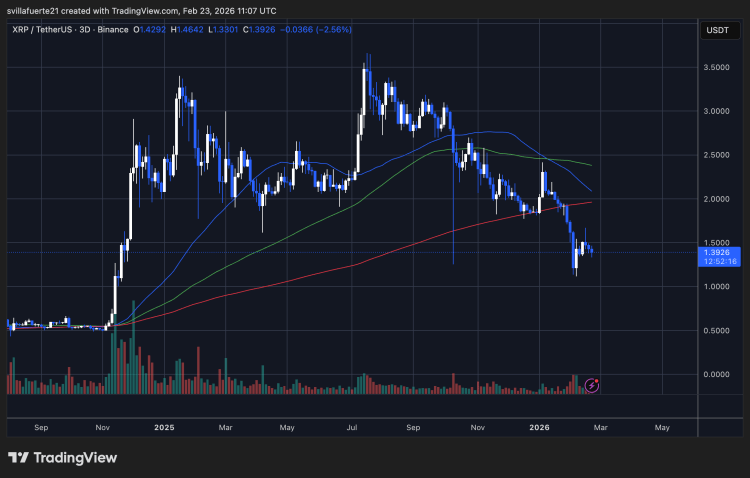
    XRP continues to trade under sustained technical pressure, with the 3-day chart confirming a broader corrective structure that began after the 2025 peak above $3.50. Since that high, price action has formed a sequence of lower highs and lower lows, signaling weakening bullish momentum rather than consolidation. The most recent decline toward the $1.30–$1.40 region places XRP at a critical support zone that previously acted as a launchpad during earlier expansion phases.

    XRP consolidates around key level | Source: XRPUSDT chart on TradingView

    Technically, XRP is trading below the shorter- and medium-term moving averages, both of which are now sloping downward and acting as dynamic resistance. The longer-term average remains upward sloping but has flattened noticeably, reflecting fading macro momentum. Until price reclaims the $1.80–$2.00 range with strong volume, upside attempts are likely to face supply pressure near these moving averages.

    Volume has moderated compared with the impulsive rally phase, suggesting reduced speculative participation. However, recent spikes during sharp selloffs indicate active distribution rather than passive drift.

    If the $1.30 support region fails decisively, a deeper retracement toward the $1.10–$1.20 zone becomes plausible. Conversely, stabilization above current levels could open the door to a short-term relief bounce, though broader structure remains fragile.

    Featured image from ChatGPT, chart from TradingView.com 

  • Ethereum Price Slides Deeper, $1,800 Emerges as Crucial Battleground

    Ethereum Price Slides Deeper, $1,800 Emerges as Crucial Battleground

    Ethereum price started a fresh decline below $1,880. ETH is now consolidating losses and might struggle to recover above $1,880 or $1,900.

    • Ethereum failed to stay above $1,920 and started a fresh decline.
    • The price is trading below $1,900 and the 100-hourly Simple Moving Average.
    • There is a bearish trend line forming with resistance at $1,920 on the hourly chart of ETH/USD (data feed via Kraken).
    • The pair could start a fresh decline if it stays below the $1,900 zone.

    Ethereum Price Dips Further

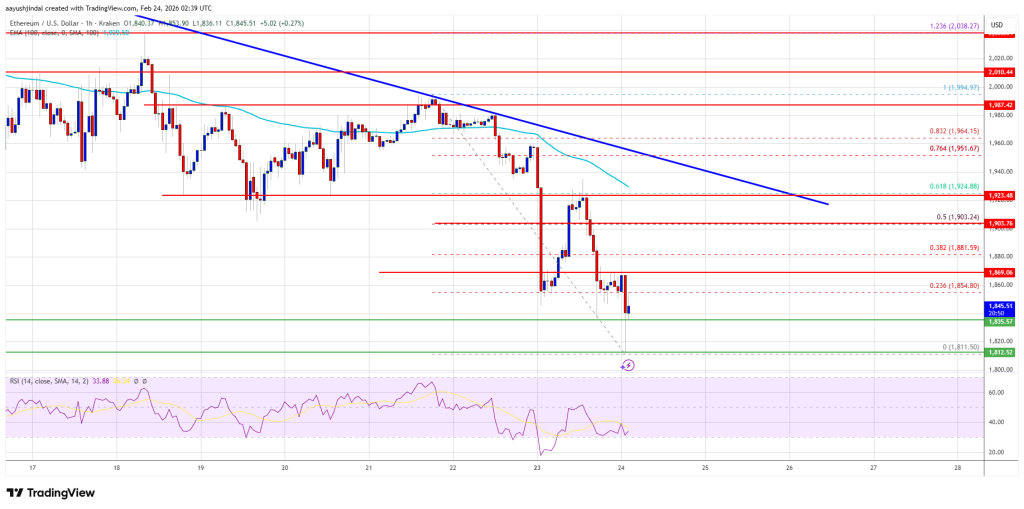
    Ethereum price failed to stay above $1,900 and started a fresh decline, like Bitcoin. ETH price traded below the $1,880 and $1,860 levels to enter a bearish zone.

    Finally, the bulls appeared near $1,810. A low was formed at $1,811, and the price started a minor recovery wave. There was a move above the $1,840 level, but the price is still below the 23.6% Fib retracement level of the downward move from the $1,995 swing high to the $1,811 low.

    Ethereum price is now trading below $1,880 and the 100-hourly Simple Moving Average. If the bulls remain in action above $1,820, the price could attempt another increase. Immediate resistance is seen near the $1,870 level.

    The first key resistance is near the $1,900 level and the 50% Fib retracement level of the downward move from the $1,995 swing high to the $1,811 low. The next major resistance is near the $1,920 level. There is also a bearish trend line forming with resistance at $1,920 on the hourly chart of ETH/USD.

    Ethereum Price

    A clear move above the $1,920 resistance might send the price toward the $1,965 resistance. An upside break above the $1,965 region might call for more gains in the coming days. In the stated case, Ether could rise toward the $2,000 resistance zone or even $2,020 in the near term.

    Another Drop In ETH?

    If Ethereum fails to clear the $1,900 resistance, it could start a fresh decline. Initial support on the downside is near the $1,835 level. The first major support sits near the $1,820 zone.

    A clear move below the $1,820 support might push the price toward the $1,780 support. Any more losses might send the price toward the $1,740 region. The main support could be $1,720.

    Technical Indicators

    Hourly MACDThe MACD for ETH/USD is gaining momentum in the bearish zone.

    Hourly RSIThe RSI for ETH/USD is now below the 50 zone.

    Major Support Level – $1,820

    Major Resistance Level – $1,900

  • XRP Price Tests Crucial Floor, Bearish Bias Strengthens Further

    XRP Price Tests Crucial Floor, Bearish Bias Strengthens Further

    XRP price extended losses and traded below $1.350. The price is now consolidating losses but faces hurdles near $1.3650 and $1.3760.

    • XRP price started another decline and traded below the $1.3450 zone.
    • The price is now trading below $1.350 and the 100-hourly Simple Moving Average.
    • There is a key bearish trend line forming with resistance at $1.4250 on the hourly chart of the XRP/USD pair (data source from Kraken).
    • The pair could continue to move down if it stays below $1.40.

    XRP Price Extends Losses

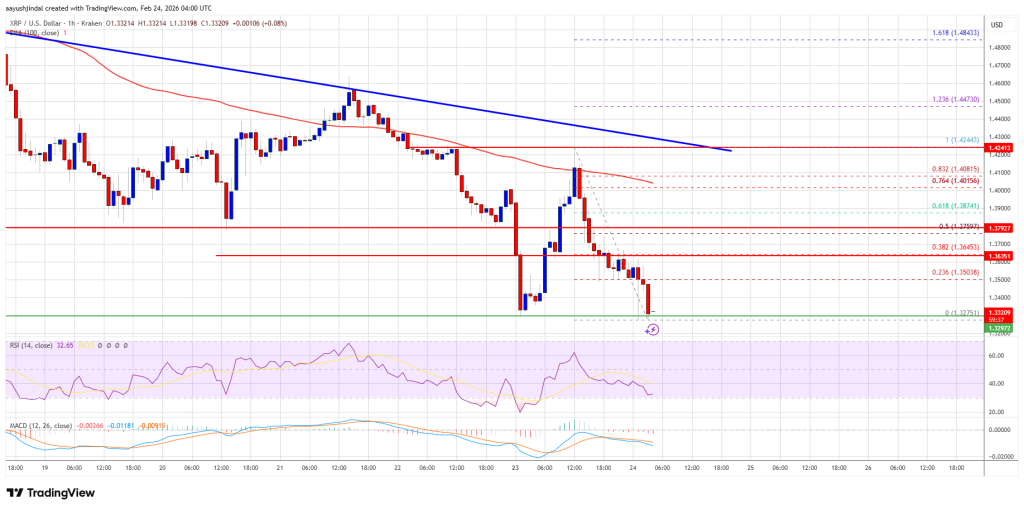
    XRP price failed to stay above $1.3880 and extended its decline, like Bitcoin and Ethereum. The price declined below $1.3750 and $1.3650 to enter a short-term bearish zone.

    The price even extended losses below $1.3450. A low was formed at $1.3275, and the price is now consolidating losses below the 23.6% Fib retracement level of the downward move from the $1.4244 swing high to the $1.3275 low.

    The price is now trading below $1.350 and the 100-hourly Simple Moving Average. If there is a fresh recovery move, the price might face resistance near the $1.3650 level. The first major resistance is near the $1.3750 level or the 50% Fib retracement level of the downward move from the $1.4244 swing high to the $1.3275 low.

    The main resistance could be $1.40. A close above $1.40 could send the price to $1.4250. There is also a key bearish trend line forming with resistance at $1.4250 on the hourly chart of the XRP/USD pair.

    XRP Price

    The next hurdle sits at $1.4450. A clear move above the $1.4450 resistance might send the price toward the $1.4840 resistance. Any more gains might send the price toward the $1.50 resistance. The next major hurdle for the bulls might be near $1.5150.

    Downside Break?

    If XRP fails to clear the $1.3750 resistance zone, it could start a fresh decline. Initial support on the downside is near the $1.3275 level. The next major support is near the $1.3200 level.

    If there is a downside break and a close below the $1.3200 level, the price might continue to decline toward $1.3050. The next major support sits near the $1.30 zone, below which the price could continue lower toward $1.2840.

    Technical Indicators

    Hourly MACD – The MACD for XRP/USD is now gaining pace in the bearish zone.

    Hourly RSI (Relative Strength Index) – The RSI for XRP/USD is now below the 50 level.

    Major Support Levels – $1.3275 and $1.3200.

    Major Resistance Levels – $1.3650 and $1.3750.

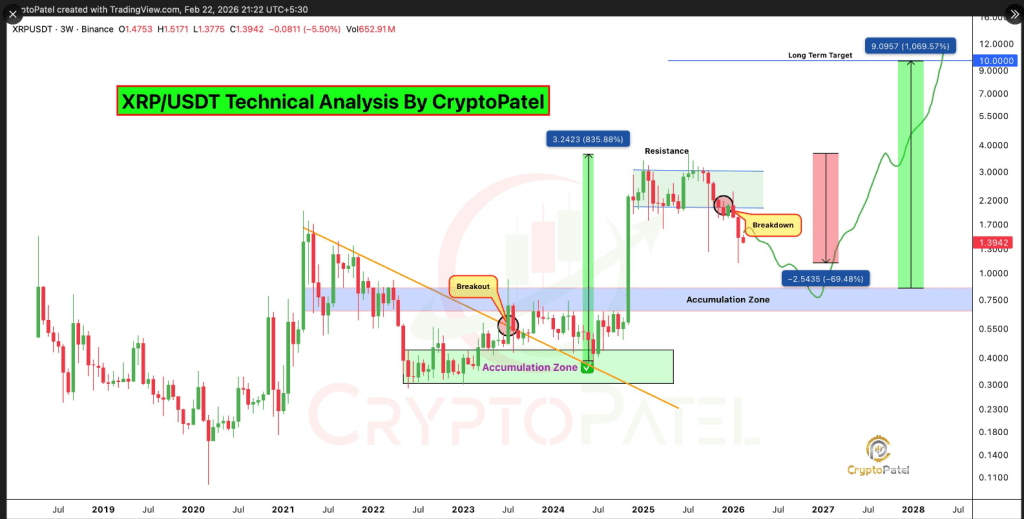
  • XRP Fell Nearly 70% — Could History Repeat With An 835% Surge?

    XRP Fell Nearly 70% — Could History Repeat With An 835% Surge?

    A sharp drop in XRP has rattled short-term holders, but some onlookers warn the sell-off may be setting a base for a much larger rebound. Reports say the token slid hard after peaking last year, and a mix of on-chain metrics and chart patterns has traders weighing whether this is panic or opportunity.

    Deep Losses And A Familiar Pattern

    According to price data, XRP fell from a high near $3.65 to roughly $1.38, a move that wiped out a large chunk of recent gains and produced a 60% pullback from the July peak.

    Traders watched as realized losses spiked, with roughly $1.90 billion recorded over one week — a level that matches past capitulation events.

    When big losses pile up in a short span, selling pressure can be exhausted and the market is often left with fewer weak hands.

    Reports note that the token is approaching a higher-time-frame demand area between $0.85 and $0.65, a zone that acted as resistance before the rally in late 2024.

    In prior cycles, that same area turned into a multi-year accumulation range where long-term buyers stepped in.

    From Panic To Jubilation

    Analyst Crypto Patel has highlighted those historical signals on social feeds, arguing the setup looks familiar and may not be permanent panic.

    He warned that XRP has dropped 69% and panic is spreading, but the last time it fell this much, it surged 835%.

    Bitcoin Moves Provide Context

    Across the broader market, Bitcoin’s swings have been a backdrop to altcoin pain. Recent sessions saw BTC shift from the high $66,000s down toward the mid-$60,000s, and that kind of volatility tends to drag other coins along.

    When BTC retreats, altcoins often fall harder, and XRP was no exception. The interplay between Bitcoin’s price action and altcoin flows is a practical reminder that macro moves still matter even when token-specific stories dominate headlines.

    Reports have recorded quick selling from short-term holders after price broke below $2, a psychological level many treated as support. That drop accelerated the move to near $1.11 in early February, which represented close to 70% drawdown from the cycle top.

    What Traders Are Watching Next

    A slice of the market exited positions in frustration. Those exits show up cleanly on-chain as realized losses, which can mark the final wave of sellers before stability returns.

    From a technical view, staying above the lower bound of the $0.65 to $0.85 band on longer timeframes would be taken as constructive by many.

    If that holds, a phased recovery could bring prior resistance levels back into play — around $2, then $3, and beyond.

    Featured image from Gemini, chart from TradingView

  • The Saylor Discount: Why Bitcoin Trading Below Strategy’s Realized Price is a Gift for Late-Cycle Allocators

    The Saylor Discount: Why Bitcoin Trading Below Strategy’s Realized Price is a Gift for Late-Cycle Allocators

    Bitcoin continues to struggle below the $65,000 level as persistent selling pressure weighs on market sentiment. Price action has remained fragile in recent weeks, with volatility elevated and traders showing limited conviction amid tightening liquidity conditions and broader macro uncertainty. While intermittent rebounds have occurred, they have so far failed to establish sustained upside momentum, leaving Bitcoin locked in a cautious consolidation phase below a key psychological threshold.

    A recent CryptoQuant report highlights a notable structural development involving StrategyB, formerly known as MicroStrategy. It has now been more than six years since the company began its Bitcoin accumulation strategy, targeting roughly 5% of the asset’s total supply. The initiative, driven by CEO Michael Saylor — one of Bitcoin’s most vocal long-term advocates — reflects a conviction that BTC could eventually surpass the $1 million mark over time.

    To pursue this objective, StrategyB has executed what many consider the largest dollar-cost averaging program in Bitcoin’s history, notably without selling any BTC since inception. Annual investment figures illustrate the scale of this effort: $1.1 billion in 2020, $2.57 billion in 2021, $276 million in 2022, $1.9 billion in 2023, $21.9 billion in 2024, $22.4 billion in 2025, and $4.1 billion so far in 2026.

    StrategyB’s Aggressive Bitcoin Accumulation And Market Implications

    According to the report, 2025 marked a record year for StrategyB in terms of capital deployed, with more than $22.4 billion invested into Bitcoin accumulation. The data suggests that 2026 is currently following a comparable trajectory. If this pace continues, the firm could surpass last year’s record, further consolidating its position as one of the largest institutional holders of BTC.

    Strategy USD Amount Invested | Source: CryptoQuant

    At present, Bitcoin is trading below StrategyB’s estimated realized price, which sits near $76,000. This metric reflects the company’s average acquisition cost across its holdings. StrategyB reportedly holds approximately 717,131 BTC, equivalent to around 3.4% of Bitcoin’s circulating supply. Such concentration highlights the scale of institutional participation now embedded in the market structure.

    However, the interpretation of this data requires caution. Trading below a large holder’s realized price does not automatically imply undervaluation; realized price is a cost-basis metric, not a valuation model. Market conditions, liquidity flows, and macroeconomic variables remain dominant drivers of price direction.

    Still, the broader takeaway is notable: even major institutional participants often rely on relatively simple accumulation strategies such as dollar-cost averaging. Whether that approach proves optimal in current conditions depends on individual risk tolerance, time horizon, and broader market context.

    Weekly Breakdown Below Key Moving Averages Signals Structural Weakness

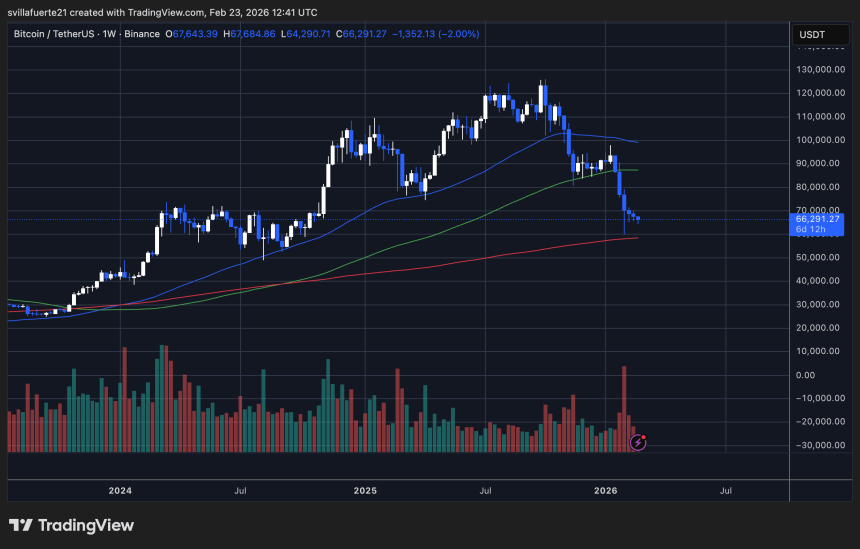
    Bitcoin’s weekly structure has deteriorated materially over the past several sessions. After failing to sustain acceptance above the $90,000–$100,000 region, price rolled over and has now retraced toward the mid-$60,000 area. The latest weekly close near $66,000 places BTC decisively below the 50-week and 100-week moving averages, both of which are beginning to slope downward.

    BTC testing critical demand level | Source: BTCUSDT chart on TradingView

    This shift in positioning is technically significant. During the 2024–2025 advance, these moving averages acted as dynamic support, consistently absorbing pullbacks and reinforcing trend continuation. Their loss now converts them into overhead resistance, limiting upside unless reclaimed with strong volume confirmation.

    The 200-week moving average, currently tracking near the mid-$50,000 zone, remains the last major structural support on this timeframe. Historically, sustained closes below the 50-week average following a cycle peak have signaled prolonged corrective phases rather than shallow consolidations.

    Volume has expanded during the recent breakdown, suggesting distribution rather than simple low-liquidity drift. The sharp selloff from the $90,000 region to sub-$70,000 levels reflects decisive supply entering the market.

    For bulls to regain control, BTC would need to reclaim the $75,000–$80,000 range and reestablish higher weekly highs. Until then, the weekly trend favors caution, with momentum tilted toward continued consolidation or further downside exploration.

    Featured image from ChatGPT, chart from TradingView.com 

  • Dogecoin (DOGE) Dips Into Red as Bearish Pressure Quietly Builds Today

    Dogecoin (DOGE) Dips Into Red as Bearish Pressure Quietly Builds Today

    Dogecoin started a fresh decline below the $0.10 zone against the US Dollar. DOGE is now consolidating losses and might face hurdles near $0.0950 and $0.10.

    • DOGE price started a fresh decline below the $0.10 level.
    • The price is trading below the $0.0950 level and the 100-hourly simple moving average.
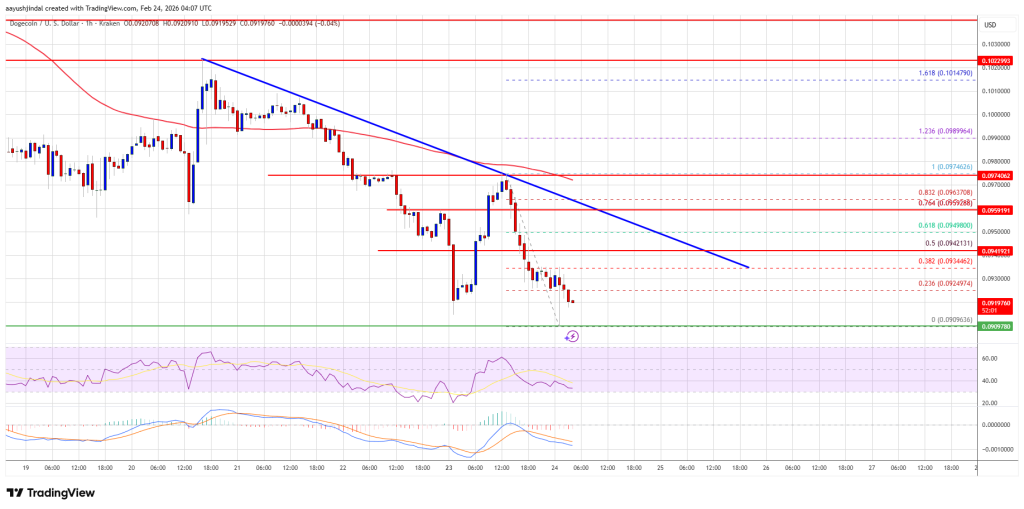
    • There is a key bearish trend line forming with resistance at $0.0958 on the hourly chart of the DOGE/USD pair (data source from Kraken).
    • The price could extend losses if it stays below $0.10 and $0.1020.

    Dogecoin Price At Risk of Downside Break

    Dogecoin price started a fresh decline after it closed below $0.1020, like Bitcoin and Ethereum. DOGE declined below the $0.10 and $0.0950 support levels.

    The price even traded below $0.0932. A low was formed near $0.0909, and the price is now showing bearish signs. There was a recovery wave above $0.0925, but the price stayed below the 38.2% Fib retracement level of the downward move from the $0.0974 swing high to the $0.0909 low.

    Dogecoin price is now trading below the $0.0950 level and the 100-hourly simple moving average. There is also a key bearish trend line forming with resistance at $0.0958 on the hourly chart of the DOGE/USD pair.

    If there is a recovery wave, immediate resistance on the upside is near the $0.0925 level or the 50% Fib retracement level of the downward move from the $0.0974 swing high to the $0.0909 low. The first major resistance for the bulls could be near the $0.0955 level and the trend line. The next major resistance is near the $0.0975 level.

    Dogecoin Price

    A close above the $0.0975 resistance might send the price toward the $0.10 resistance. Any more gains might send the price toward the $0.1020 level. The next major stop for the bulls might be $0.1050.

    Downside Break In DOGE?

    If DOGE’s price fails to climb above the $0.0958 level, it could continue to move down. Initial support on the downside is near the $0.0910 level. The next major support is near the $0.090 level.

    The main support sits at $0.0880. If there is a downside break below the $0.0880 support, the price could decline further. In the stated case, the price might slide toward the $0.0832 level or even $0.0820 in the near term.

    Technical Indicators

    Hourly MACD – The MACD for DOGE/USD is now gaining momentum in the bearish zone.

    Hourly RSI (Relative Strength Index) – The RSI for DOGE/USD is now below the 50 level.

    Major Support Levels – $0.0910 and $0.0900.

    Major Resistance Levels – $0.0955 and $0.0975.

  • History Repeating? XRP Flashes Signal Last Seen Before Explosive 60,000% Rally

    History Repeating? XRP Flashes Signal Last Seen Before Explosive 60,000% Rally

    XRP is on track to close its fifth consecutive month in negative territory, a rare stretch of sustained losses that has not been seen since late 2016. Despite holding at around $1.30, the token has declined nearly 30% in February alone, according to CoinGecko data, extending a broader five-month decline of roughly 50%.

    XRP Flashes Pre-Bull Run Pattern

    The last time XRP recorded five straight red monthly candles was between October 2016 and February 2017. During that period, the price slipped from $0.00885 to $0.00557, a decline of 37%, before finding a bottom near $0.0055 in March 2017. By May 2017, XRP had surged to $0.3988 — a gain of 7,000% in just two months. 

    After consolidating through the summer, the token climbed again, eventually reaching $3.31 in January 2018. From its March 2017 low, that marked a 60,000% increase.

    With XRP now following a similar path, market analyst Sam Daodu examined the comparison in a new report released on Monday.

    Daodu noted that the current setup “rhymes” with the 2016–2017 structure: five consecutive months of declines, tightening price action, and signs that selling pressure may be exhausting itself. However, he cautioned that the market environment has changed dramatically since XRP was “a micro‑cap token.

    In 2017, XRP’s total market value was less than $300 million. Daodu pointed out that at that level, even a few hundred million dollars in new capital might raise the price by thousands of percentage points. 

    Today, XRP has a market capitalization of about $88 billion. According to the analyst, this scale makes a 60,000% surge virtually impossible under any realistic market conditions.

    250% Rally Still In Play

    A comparable rally would imply a move to roughly $852 per token. With approximately 58 billion XRP in circulation, that would translate to a market capitalization exceeding $49 trillion — more than the combined value of all stocks listed on the New York Stock Exchange. 

    Still, Daodu argues that while a repeat of the 2017 explosion is off the table, a meaningful recovery remains within reach if the bottoming pattern holds. 

    A return to XRP’s July 2025 high of $3.65 would represent a gain of about 157% from current levels. A move toward $5 — near the upper range of analyst forecasts for 2026 — would amount to a 252% increase.

    Even more conservative projections suggest room for upside. Standard Chartered recently reduced its XRP target by 65%, citing near‑term headwinds, but its revised forecast of $2.80 would still imply a roughly 97% rise from current trading prices.

    XRP

    The key difference in this cycle, according to Daodu, lies in the source of demand. The explosive rally of 2017 was largely driven by retail speculation. 

    In contrast, any substantial gains this time would likely depend on institutional flows, including potential exchange‑traded fund (ETF) inflows, broader institutional adoption, and a recovery across the wider crypto market.

    While another 60,000% run is unrealistic, Daodu believes a 150% to 250% advance is achievable if momentum shifts and capital returns to the sector.

    Featured image from OpenArt, chart from TradingView.com 

  • Bitcoin Capitulation Persists As Short-Term Holders Realize $0.48B Daily Losses

    Bitcoin Capitulation Persists As Short-Term Holders Realize $0.48B Daily Losses

    On-chain data shows the Bitcoin short-term holders continue to capitulate as they are realizing net losses of $0.48 billion every day.

    Bitcoin Short-Term Holder Net Realized Profit/Loss Is Notably Red

    According to data from on-chain analytics firm Net Realized Profit/Loss has been negative for the Bitcoin short-term holders recently. This indicator measures, as its name suggests, the net amount of profit or loss that BTC investors are harvesting through their selling.

    The version of the metric that’s of relevance here specifically tracks this for the short-term holders (STHs), a BTC investor cohort that includes only buyers from the last 155 days.

    Statistically, the longer an investor holds onto their coins, the less likely they become to sell them in the future. Since the STHs represent the new entrants into the market, their resilience tends to be low, and they may take part in panic selling during market volatility.

    Recently, Bitcoin has faced a major drawdown and the STHs have naturally reacted to it. Below is the chart shared by Glassnode that shows how the 7-day exponential moving average (EMA) of the Net Realized Profit/Loss has fluctuated for this group during the recent volatility.

    Bitcoin STH Net Realized Profit/Loss

    As is visible in the graph, the Bitcoin STH Net Realized Profit/Loss saw a deep plunge into the negative territory during the price downturn that followed the October high, implying realized losses notably outweighed the profits. In January, the metric recovered toward the neutral mark as the market saw an uplift, but the price drawdown since the end of the month has again taken the indicator to a highly red level.

    On February 6th, the STH Net Realized Profit/Loss fell to a value of -$1.24 billion per day, notably lower than the red peak observed last year. Since this low, the metric has risen a bit and today, it’s sitting at -$0.48 billion per day. “While the intensity has cooled, the broader regime still signals a market under pressure, with participants in the base formation phase continuing to capitulate,” explained the analytics firm.

    In some other news, the Bitcoin Coinbase Premium Gap has been negative recently, as highlighted by CryptoQuant author IT Tech in an X post.

    Bitcoin Coinbase Premium

    The Coinbase Premium Gap tracks the difference between the Bitcoin spot price listed on Coinbase (USD pair) and that on Binance (USDT pair). From the chart, it’s apparent that the metric has maintained at red values since mid-December, indicating that Coinbase users have been applying a higher amount of selling pressure than Binance traders.

    Coinbase is mainly used by US-based investors, especially the large institutional entities, so this trend can be a sign that there isn’t much demand for BTC among them right now.

    BTC Price

    Bitcoin has been slipping deeper as its price is now trading around $64,000.

    Bitcoin Price Chart

  • Here’s What’s Driving The Bitcoin Price Crash Toward $60,0000

    Here’s What’s Driving The Bitcoin Price Crash Toward $60,0000

    In six months, the Bitcoin price has crashed by around 50%, dropping below $64,000 at the start of this month. Naturally, this has triggered a cascading event, with devastating effects on the rest of the market, and questions about what could be driving the decline. With no notable event driving the crash, as was seen in 2022 with the crash of the FTX crypto exchange, the simple answer has pointed to one thing: large investors are selling.

    Corporate Holders Are Getting Out Of Bitcoin

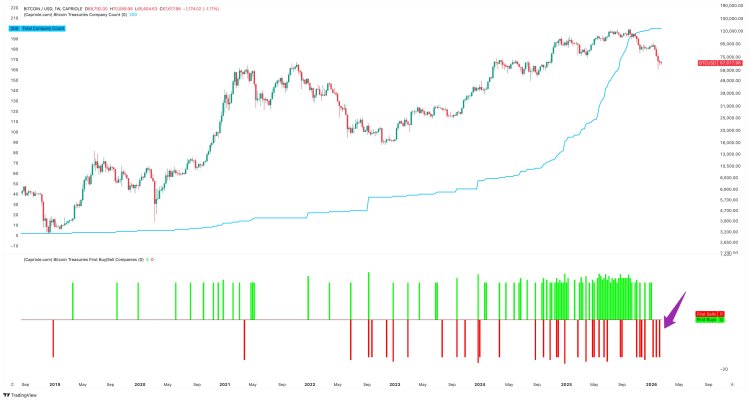
    In an X post, Coin Bureau highlighted an interesting trend among corporate Bitcoin holders that could explain the sustained decline the digital asset has suffered in recent times. According to the chart shared on the post, these large corporate holders have been dumping their holdings.

    For the better part of 2025, there had been a clear trend of accumulation among corporate buyers. Sometimes, the buying trend would be sustained for weeks before a sell-off trend would be recorded. However, this is quickly changing as the last few weeks have been dominated by dumping.

    The post showed that in the last three weeks, there has been no buying done. Rather, corporate investors have been dumping BTC on the market. For context, the longest selling streak among these large investors recorded in history was two weeks before buying began again.

    However, at the time of writing, only outflows have dominated the treasuries of these companies, marking a new record since companies began buying Bitcoin in 2020. Given this, it is possible that the accumulation trend that drove Bitcoin to new all-time highs in 2025 may have ended.

    Bitcoin sell-offs

    Data from CoinShares also corroborates this sell-off trend. In its Digital Asset Fund Flows Weekly Report, it shows that in just the last week alone, Bitcoin lost $215.3 million to outflows from digital asset funds, thereby leading the sell-offs.

    In the same vein, Ethereum suffered outflows of 36.5 million, and multi-asset funds saw $32.5 million in outflows. Interestingly, though, the likes of XRP and Solana continue to see inflows, despite their poor performance in the market.

    Given this trend, it shows that corporate investors are looking to altcoins for likely higher profit margins compared to Bitcoin. As supply continues to pile up in the market, it is likely that the Bitcoin price will continue to fall until buying picks up once again.

    Bitcoin price chart from Tradingview.com